
The most intense stretch of the 2026 political advertising cycle is underway.
AdImpact now projects political advertising spending will reach $11.6 billion this cycle, surpassing both the $8.9 billion spent during the 2022 midterms and the $11.2 billion spent during the 2024 presidential cycle.
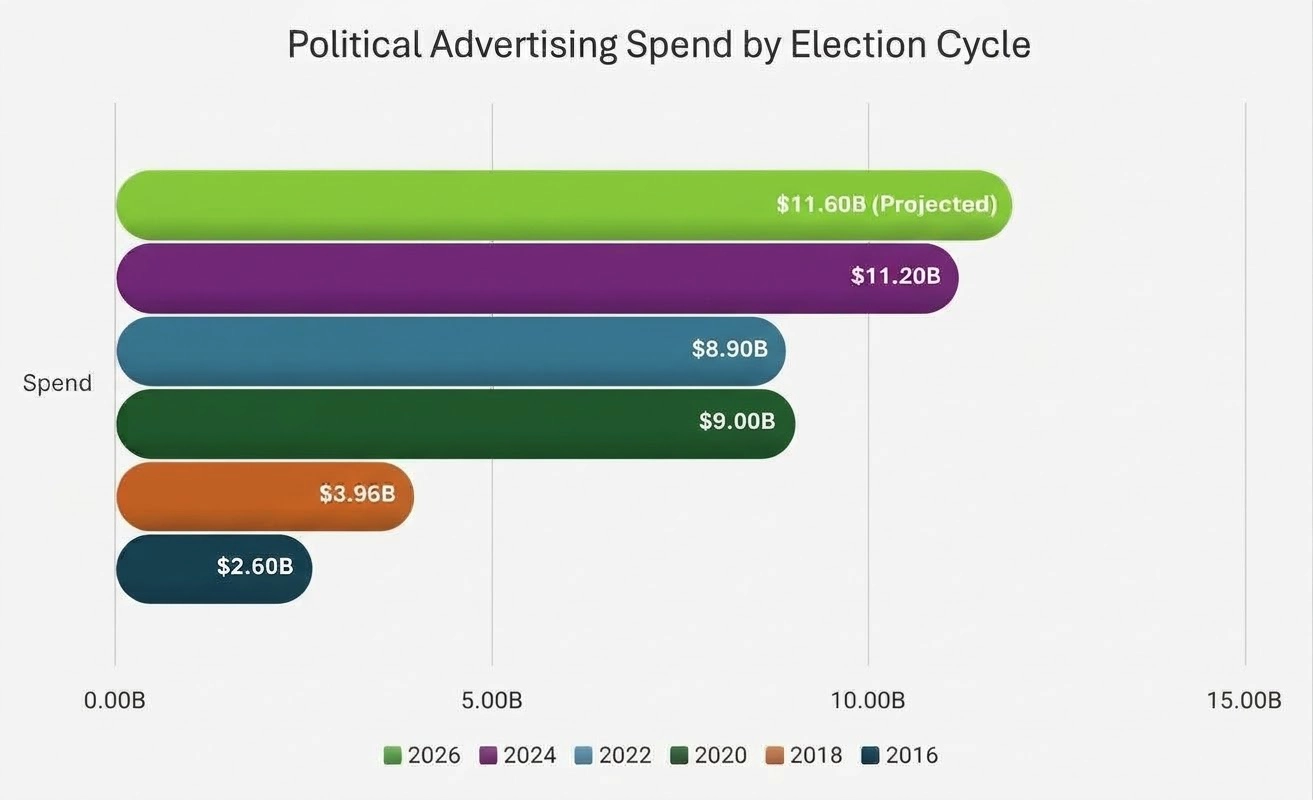
For commercial advertisers, however, the size of the political spend is only part of the story. The more important question is what that spending does to the media marketplace—and what advertisers should do about it now.
With the 60-day window preceding the November 3 general election already underway, the opportunity to simply plan around political pressure has largely passed.
This is now a media management issue.
Advertisers need to protect the inventory that matters, monitor delivery closely, maintain flexibility across the media mix and be prepared to move when market conditions change.
Political Pressure Is No Longer Just a Broadcast TV Problem
Political advertising has historically been associated most closely with local television. But the marketplace has changed.
Through August 24, approximately $6.1 billion in political advertising had already been placed across media. For the full cycle, AdImpact projects $2.7 billion in CTV and streaming—approximately 23% of total political advertising spending.
That matters because many commercial advertisers have historically viewed streaming as an alternative when linear television inventory becomes crowded.
In 2026, that assumption deserves another look.
Political advertisers are using CTV and streaming for many of the same reasons commercial advertisers do: audience targeting, geographic precision and access to consumers beyond traditional television.
CTV remains an important part of a diversified video strategy. But it is no longer an automatic escape route from political advertising pressure.
The Impact Is Local
National political spending totals get the headlines, but commercial advertisers experience the pressure market by market.
Federal, gubernatorial, state legislative and local races can overlap within the same geography, creating concentrated demand for finite inventory. Preferred programs or dayparts may become harder to secure, and inventory available when a plan was developed may disappear.
For destinations, attractions and outdoor recreation brands, the stakes can be even higher. A campaign tied to fall travel, a seasonal event or a specific visitation window may not have the flexibility to simply shift timing.
The objective should not be to avoid advertising because the market is crowded. It should be to determine which parts of the plan are essential to the business objective and protect those first.
The 60-Day Window Changes the Marketplace
Federal rules require broadcast stations to provide legally qualified candidates with the lowest unit charge for comparable advertising during the 60 days preceding a general election. For the November 3, 2026 election, that window began September 4.
For commercial advertisers, the bigger issue is the volume of demand entering the marketplace at the same time. As political spending accelerates toward Election Day, availability can change quickly.
What Commercial Advertisers Should Be Doing Now
Protect the Inventory That Matters Most
Identify the markets, programming, audiences and periods most important to campaign performance, and focus attention there as inventory tightens. The goal is not to preserve every individual placement. It is to preserve the audience delivery and business objective behind the plan.
Build Flexibility Into the Mix
Advertisers should understand their alternatives before they need them. That may mean shifting between stations or dayparts, adjusting flight dates, using other video environments or moving investment into channels where audience reach can be maintained more efficiently.
Don’t Treat CTV as the Automatic Backup Plan
Streaming can provide incremental reach, targeting and additional inventory, but political advertisers are there too. Evaluate CTV within the full video marketplace rather than automatically moving television dollars into streaming when linear inventory tightens.
Think Beyond Video
Radio, paid social, digital, search, OOH and other channels can help maintain visibility and reach when portions of the video marketplace become constrained. The point is not to replace television simply because political demand is high. It is to make sure the campaign is not dependent on one crowded channel.
Pay More Attention to Creative
Inventory is not the only thing getting crowded. Consumers are also entering a period of unusually high advertising frequency and message volume. Commercial creative has to work harder to earn attention amid a constant stream of political messaging.
The Bigger Lesson for Advertisers
Political advertising is becoming a more persistent force across the media ecosystem. Spending is larger, activity begins earlier, and competition increasingly extends beyond broadcast television into CTV, streaming and digital platforms.
The answer is not to retreat from the marketplace. It is to manage it more deliberately.
Protect the inventory that matters most. Maintain alternatives across the media mix. Monitor campaign delivery closely. Evaluate video holistically rather than treating streaming as a workaround. And make sure creative is strong enough to earn attention.
For advertisers tied to specific seasons or travel periods, that discipline becomes even more important. A limited business window can make lost reach more damaging than a higher media rate.
Political advertisers have a deadline: Election Day.
Commercial advertisers have something just as important: a business objective.
The media strategy should remain built around that objective—even when the marketplace around it is anything but predictable.
Frequently Asked Questions
How much political advertising is expected in 2026?
AdImpact projects approximately $11.6 billion in political advertising spending during the 2026 election cycle, exceeding both the 2022 midterm cycle and the 2024 presidential cycle.
Will political advertising affect commercial TV buys?
It can. Heavy political demand increases competition for available local television inventory, particularly in markets with multiple active races. Commercial advertisers should monitor availability and delivery closely and be prepared for schedules to change as Election Day approaches.
Is CTV a solution to political TV competition?
CTV can provide additional reach, targeting and inventory, but it should not be viewed as an automatic workaround. Political CTV and streaming spending is projected to reach $2.7 billion in 2026, or approximately 23% of total political advertising spending.
What should commercial advertisers do during the weeks before the election?
Prioritize the inventory and audiences most important to the business objective, identify alternatives across channels and placements, monitor campaign delivery closely and maintain enough flexibility to adjust the media mix as market conditions change.