
Dark tourism might include travels to battlefields, genocide memorials, disaster sites, former prisons, accident sites, and the locations of historical atrocities. So, for as morbid as it sounds, you would be forgiven for thinking this is a niche category.
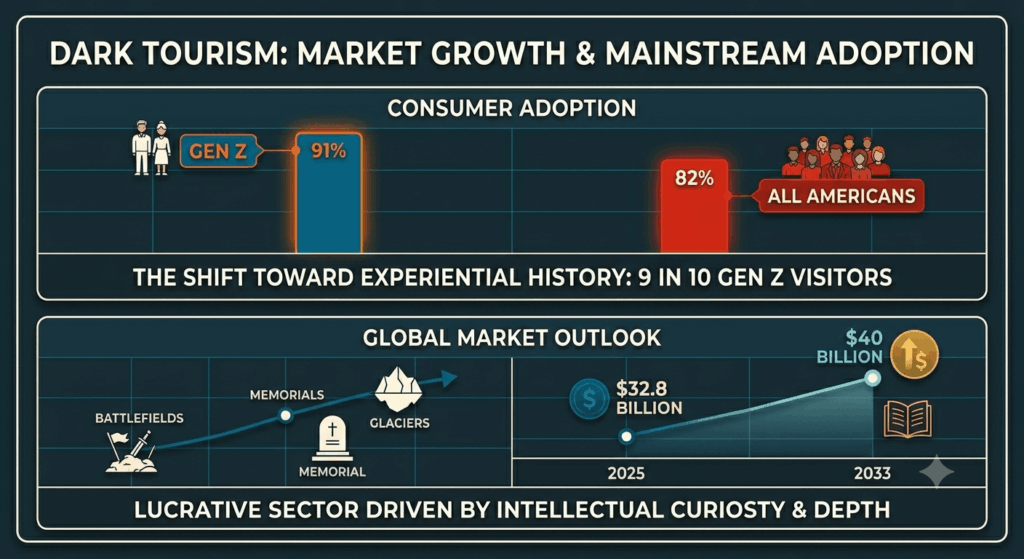
Surprisingly, 91% of Generation Z have visited at least one dark tourism site, and 82% of all Americans have done the same. By any definition, this is mainstream travel behavior. Even so, marketers have to apply a completely different set of instincts about restraint and honest communication.
To help you understand consumers and get these things right, we covered meaning and memory as core motivational drivers in experience-based travel in our strategic brief, Winning the Experience-Driven Consumer, which you can find here. Now, let’s dig into dark tourism and how your campaigns can avoid getting stuck in morbidity.
Dark Tourism: What It Actually Is
For something that deals with the most sensitive parts of history, dark tourism is surprisingly lucrative. The dark tourism market reached approximately $32.8 billion in 2025 and is expected to reach $40 billion by 2033.
The site-level data is equally fascinating. Auschwitz attendance rose nearly 10% in 2024 versus 2023. The 9/11 Memorial & Museum grew from 2.2 million to 2.4 million visitors in the same period. At the same time, Hiroshima set a record, exceeding 2 million museum visitors for the first time.
The traveler visiting these places isn’t looking for entertainment; they are looking for understanding. They crave a connection to history that feels honest and weighted. Marketing that trivializes, overpromotes, or adopts a glossy-magazine tone on these sites will push the target audience away, likely permanently.
Getting the Tone Right
With something as heavy as dark tourism marketing, it’s all about getting the tone right. While your instinct might be to back off from the weight of the destination, it’s better to acknowledge it honestly. You want to project confidence in the value of the experience. First-person testimonies can go a long way in this regard.
On the other hand, superlatives or promotional language are all but guaranteed to push the target audience away. Social media content that prioritizes shareability over respect for the gravity of the situation is bound to fail. Avoid photography that seems to glamorize the suffering.

The 9/11 Memorial & Museum is one location that gets it right. The museum uses first-person oral histories and survivor artifacts and avoids flashy copywriting. The Anne Frank House in Amsterdam has mastered the art of digital restraint, offering quiet, educational virtual tours that focus on historical preservation. These institutions understand they are stewards of memory, and their marketing reflects this confidently.
Doom Tourism Is Slightly Different
Doom tourism is related to dark tourism, but it requires a slightly different approach. The experience centers around travel to threatened or disappearing places: glaciers, coral reefs, Arctic ecosystems, and sinking island nations. The traveler will not witness historical suffering, but they will get a close-up look at environmental loss. The emotional driver is grief, not morbidity.
About 26% of American travelers find this type of tourism appealing, according to research conducted in late 2024. However, marketing a disappearing glacier as a must-see attraction before it is gone is a very fine line to walk. Done well, this kind of communication can mobilize genuine environmental concern and generate advocacy beyond the visit. Done poorly, it reads as the exploitation of loss for commercial gain.
Educational and Heritage Travel: All About Learning
Educational and heritage travel succeeds by distinguishing the experience from casual sightseeing. The educational heritage traveler comes prepared with prior knowledge but also wants to learn. They want depth, access, and context that goes beyond what a standard guided tour provides.
Institutions like Road Scholar and National Geographic Expeditions have built entire businesses serving this intellectually curious traveler. If a destination or brand has genuine historical or educational depth, it should explicitly convey that depth in its marketing.
Ultimately, educational travelers are not motivated by beautiful photography. They are motivated by the promise of learning something they could not learn anywhere else.
Overcoming the Challenges
Now that we’ve wrapped up our series on experiential marketing, it’s clear that every cluster faces serious marketing challenges. For dark tourism, doom tourism, and educational heritage travel, that challenge is entirely about tone and trust.

Brands that approach these categories with honest restraint and genuine respect for the weight of the experience will build visitor relationships that are among the most loyal and emotionally connected in the industry. Brands that apply standard promotional instincts to these categories risk coming off as crass or heartless.
To help you avoid these traps, we built a free Brand Grader that scores your website and marketing content to make sure the tone matches the gravity of what you’re offering. It only takes a few minutes, so try it out today by visiting here.
Source List
Credence Research, Dark Tourism Market Report
Grand View Research, Dark Tourism Market Size, Share & Growth Report
Future Partners, State of the American Traveler